Showing posts with label Ahmedabad. Show all posts

Monday, January 23, 2012

Kalamkari of Gujarat/Mata ni Pachedi


India has a rich textile tradition,no doubt and the artist has developed several mediums to express his imagination on to the canvas in many ways.Religious textiles portray the Indian culture to a great extent.Gujarat also has a Kalam kari art of its own and its called Mata ni Pachedi. `Having read about Mata ni Pachedi,before the trip,I was very sure that I wanted to see an artist who does this art,visit him and learn .Our driver Johnny knew each art of gujarat in detail and he took us through some very narrow gulleys in the main town of Ahmedabad to show the artist at work.
This Religious textile Art is done in a cream coloured cloth.They are hangings painted with iconographic representation of  gods and goddesses.They usually form the backdrop behind Goddess Durga in temples .If the devotees wishes come true they offer  it to the lord.During the festival season this art work is in demand in villages .In earlier times,the whole work used to be done by hand.Now they have blocks available.the sides of the cloth is decorated using blockprints and then the inside is handmade.

I think its now getting evolved from religious purposes to objects of decoration.
the  representation of goddess Durga at the artists work place
his fathers photograph

the photographs of all gods at the artists workplace


Goddess Durga
Depicting Ramayana
another form of Goddess


Goddess Saraswathi devi

In the chariot 

Blockprints

artist at work,black colour is coal mixed in oil and kept in tins for days

glory of the Raja

my enthusiastic daughter even captured a video of his work
a glance at his two room house,the kitchen where the vessels are arranged  on shelves


Images and Ideas:Lakshmi Arvind
Pl do not steal the images.

Monday, January 9, 2012

Mangaldas ni Haveli,Cafe and craft Centre

A trip to Ahmedabad three months back and still I sit for long hours in front of these charming images. The restoration of old monuments, havelis, heritage walks are all a part and parcel of Ahmedabad. With a 7 month old baby it was difficult for us to go for heritage walks, so we took an Autorickshaw. The best way to see the city is in an autorickshaw driven by  the loving "Mohammed Bhai". Is there any tourist who comes to Ahmedabad  who doesn't know Mohammed bhai..? Mohammed Ghulam Ahmed, a man trained by the Ahmedabad Heritage Committee. Want to know everything there is to the walled city’s heritage? Mohammed Bhai will tell you when and who built a particular mosque or temple, and just what is so special about it. Mohammed Bhai knows more than Ahmedabad’s history or its architectural gems. Very few havelis allowed us inside and one such haveli is the Mangaldas ni Haveli. As in all other Havelis, this one also has a courtyard, frescoes and brackets and so on..

Mangaldas ni Haveli is located in the heart of the historic walled city of Ahmedabad. It is estimated to be over 200 years old and it originally belonged to a Nagar Brahmin family (Brahmins were considered the highest amongst all castes in India). It is one of the finest examples of carved wooden architecture typical of that time. It was bought by the Mangaldas family in 2006 and has since been restored. It now houses a cafĂ© and a Learning Centre and is accessible by a shuttle service from The House of MG.


was glad the old switches were retained

the door detailing
the courtyard, the airy one

balls and hearts were found tied and they were dancing to the tune of wind


the way up
the doors also had these lotus representations
the windows,huge and large
the cafe centre which is closed now
motifs on the terrace
lovely lotus motifs on the walls,signature of house of MG
loved this one on the parapet lining

the old world feel

steps to keep the pots..
 Still charmed and very charmed and will keep on posting about Ahmedabad..We have travelled to many cities and no city has charmed us so much as this city keeps us haunting for more....

Images and Ideas:Lakshmi Arvind


Tuesday, January 3, 2012

The Old World Charm: the Pols of Ahmedabad


Time has bestowed beauty to the pol architecture of Gujarat, making it an ornament of world architecture. The 21st century, the century of urbanisation, aims to achieve the goal of harmonious cities by focusing on developing harmonious relations between the spatial, the social and the environmental aspects of the cities.

Having read so much about the pols, we  wanted to imbibe the essence of the old city in all its means, we stayed in a place in one of the pols, and we spent  time loving the old city. I loved the close knit environment, the colourful doors and the loving people behind them. Ahmedabad to me is just a melting pot of cultures, religion and traditions. In this, the rapidly developing new Ahmedabad has a lot to learn from the heritage of the walled town. Without proper knowledge of the pols, our knowledge of Ahmedabad is incomplete. These pols are the real identity of Ahmedabad. The word ‘Pol’ conjures up an image of an old world charm and a series of innovations in sustainable architecture dovetailed into the built form. ‘Pol’ architecture is an interesting evolution in urban living space. 

The pols of old Ahmedabad are old residential areas dating back to 1714. The word 'Pol' is derived from a Sanskrit word 'Pratoli' . The 'Pols' were known as 'Pada' in the Solanki period. It is said that when Sultan Ahmed Shah found the city, he stayed in the pol in the beginning. This pol was known as 'Mahurat Pol', which is now in Manekchowk. The construction of new pols continued and even increased during - Maratha Rule. Many pols were constructed during the years 1760 to 1818. 

.


The city has many big and small pols ranging from six house pol (Ghar-ni-Pol) to pols having about 3,000 houses (a big settlement). The biggest pol of Ahmedabad is known as Mandavi-ni-pol. At present, there are about 60,000 houses in 600 pols of Ahmedabad. Reflecting the rich cultural ethos of Gujarat, pols have their geographical origins in the north of Gujarat. Known as "padas" in the north Gujarat towns like Patan, pols are a key to the understanding of what is called the settlement pattern of Gujarat. Originally, people of the same caste or social group would live together in a "khadki" and a group of "khadkis" would make a pol. During the Muslim period, the residential areas meant for the high officials of Ahmedabad were called "puras". Each pura would have many pols lived in by people who were attracted by the opportunities that the city had to offer.

They are honeycomb like community dwellings enclosed by a wall and protected by huge gates. There are about 360 pols in the old city of Ahmedabad alone. Many of these pols have colourful names, reflecting the richness of Gujarati language. These densely packed clusters of rows upon rows of houses, joined by labyrinthine streets are where thousands of years old Indian architectural traditions continue to live. These pols are an exuberant riot of beautiful wooden facades, lovely wooden brackets, lovingly carved fenestrated windows, magical balconies,otlas, carved wooden chabutaras (bird feeders) for feeding pigeons, khadkis and chowks, a main street with crooked lanes branching on either side, secret entrances, walls and gates which were barred at night, temple, playing areas, sculptured wooden doors, windows, beams, pillars and balconies. The central open space is known as the chowk and the rest of the zones are built around it.


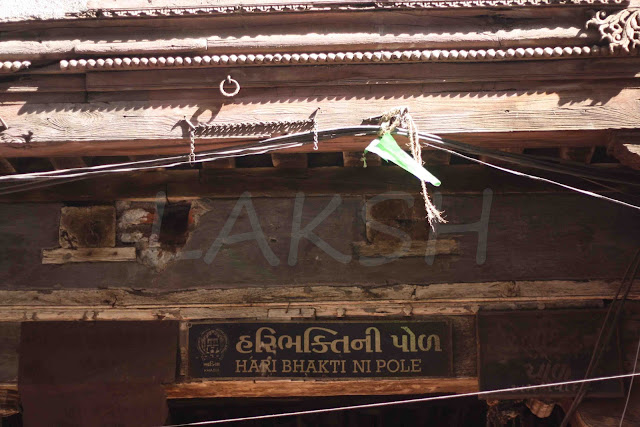


More about the peeling paint, open windows, closed doors, coloured facades in the next few posts..

All images Lakshmi Arvind. Text courtesy here, here, here and here.
Related Posts with Thumbnails