Showing posts with label Blue pottery. Show all posts

Tuesday, May 3, 2011

Saundhi Mitti


Thanks Ruchira for the mail,otherwise would not have known you for long.The first online collective pottery shop,based in Delhi.The only pottery boutique with works from 20 plus potters across the country and the list is everchanging and thts "Saundhi Mitti".They all look absolutely pretty and i cant wait to get back to Delhi.

After nearly 11 years of a corporate career, I realised my heart lay with pottery, and I've been messing around with clay for a year now. I absolutely love it says Ruchira from Saundhi Mitti..A treasure chest of exquisite pottery pieces,so why wait?

Modern twist to exquisite pieces,very traditional and eclectic ones,modern ones,functional items,decoration items and knickknacks ....and a lot of them ,you will love it...
The website is almost ready to go online ,but why wait,connect them through your facebook at saundhi mitti.I am glad to have known so many of Indias talent an amazingly creative people.

curvy shape, but with 3 varying shades of brown and a double-spiral lid. Yummy!
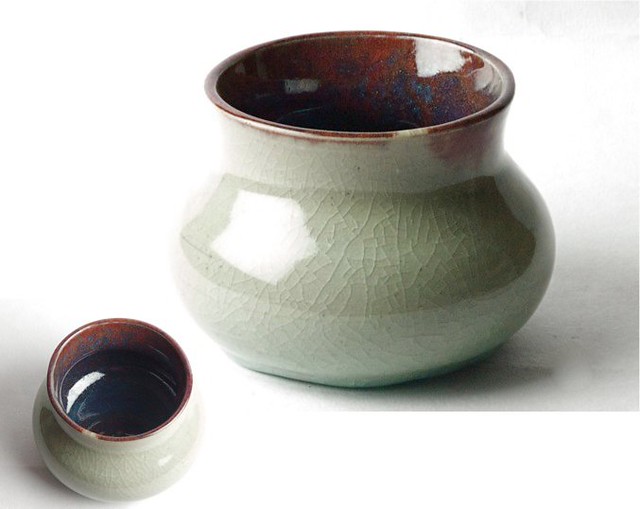
traditional pot in the with a lovely rusty maroon glaze inside. 9 cms tall, 13 cms wide
a black and pale green teapot, almost sculptural in shape, dome-like lid, crackled glaze finish on the body; a perfect gift for someone into artsy home decor.
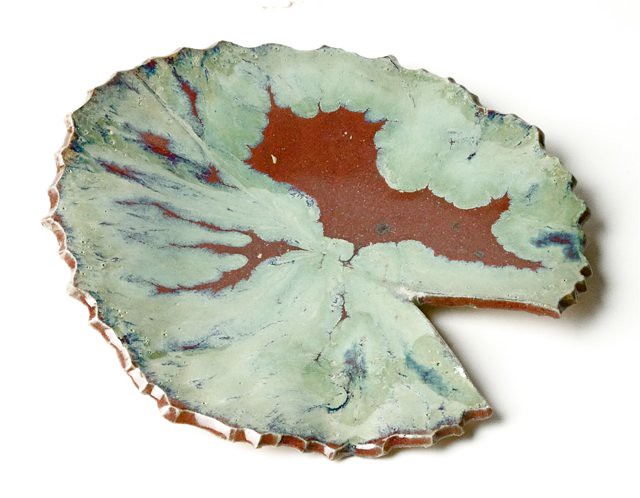
A one-of-its-kind lotus leaf platter, with green and ochre glazes, and cutwork on the edges. Perfect as a centerpiece, add a candle or potpourri for effect. An ideal housewarming gift :
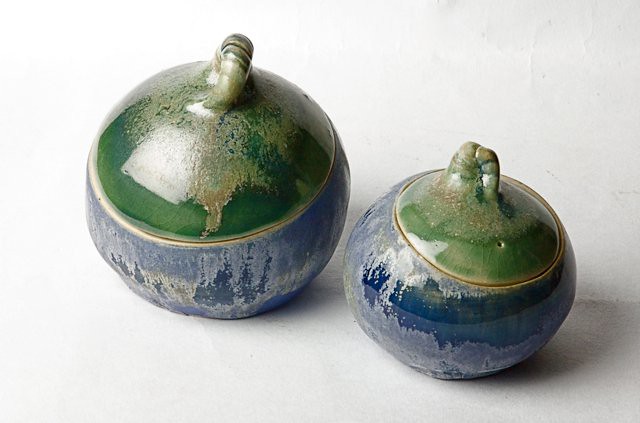
pair of baingans: crackled green glaze on the lid, aubergine glaze on the body. Use just for decor, or serve saunf-supari in them after dinner. Guaranteed conversation-piece :-) By Sona.
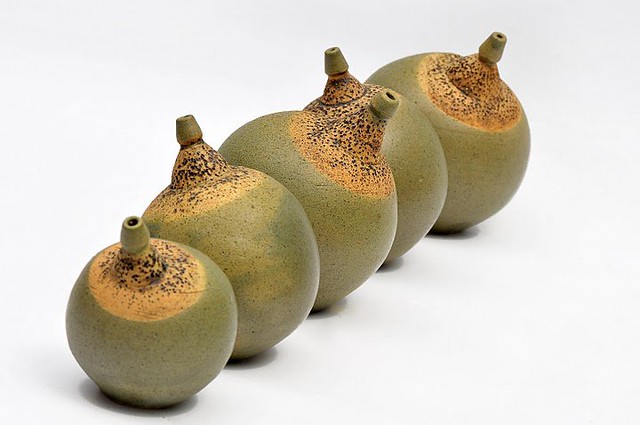


n artistic installation – 5 spheres, each identical, yet unique. Creative glazing – green with specks of black. Unusual form – great as a centerpiece or the highlight of your mantle


Teabowls,how could i leave them?
Coral-green glazed bowls with brown accents. Unusual hues on a classic clay form, by my dearest friend Prachi from Purplehomes
All images courtesy:Saundhi Mitti

Friday, April 23, 2010

The Art of Blue Pottery


A post long overdue.

Visit to Rajasthan becomes an intention and all the more interesting during winters.
Last visit to Rajasthan ,was to Jaipur and visiting Sanganer was one among our itineries..
We enjoyed being among the world of  blue pottery factories and pots and block prints... 

Some behind the scenes from the factory

Origin 

Blue pottery though Turko-Persian in origin, is widely recognized as a traditional craft of Jaipur. Legend has it that blue pottery came to Jaipur in the early 19th century when one of its rulers, Sawai Ram Singh II (1835 – 1880) set up a school of Art and encouraged artists and craftsmen from all over the country to come and settle here – a tradition started by his fore-fathers. Blue pottery has seen several ups and downs in its lie span of almost 200 years. There was a time when  it all but vanished from Jaipur but the efforts of several concerned people like Smt. Kamla Devi Chattopadhaya and Ramata Gaytri Devi helped to revive this dying art. 
Today, blue pottery is a growing industry, an industry that provides livelihood to thousands of people.

The Process

Blue Pottery is based on ground  quartz. The dough is pressed into moulds and the unfired pieces are hand painted with oxide colours, dipped in clear glaze and fired once in wooden kilns. The process is very tedious and time consuming. Once made, the blue pottery items cannot be reworked. It is a craft where one is never sure if the finished product will have the exact shade that one may have wanted. The smallest mistake could lead to the piece either cracking up or turning black.This tedious process was one of the main reasons why very few people were willing to experiment and try out new products in blue pottery. Not only did it require time and patience but also money. Blue pottery survived as a decorative item – ideal for gifts and souvenirs. But its practical use was very limited.

The Jaipur mix usually contains no clay at all. It is made up of 100 kg (220lbs) of ground quartz, 10-20 kg (22-44 lbs) of green glass, ½ kg (I lb) of fuller’s earth ½ kg (I lb)  of borax and 1 kg (2.2lbs) of gum. This is kneaded into a dough, flattened and pressed into an open mould. A vase, for example, will be made up in four parts; a wheel-turned neck; two moulded hemispheres; and a wheel-turned base. The hemispheres are filled with ash or sawdust while they dry, the parts are joined and the surface smoothed over, and the vase is then taken for painting. The outlines are drawn in cobalt oxide using a squirrel-tail brush (little ground squirrels are frequently run
 over, and the painters collect the tails, from which they make their own brushes). 


The design is filled in with other metal oxides, each of which is transformed into a bright colour by firing. The oxide of cobalt becomes a deep blue, that of chromium changes to green, cadmium produces a bright yellow and iron oxide becomes a red-brown. The piece is then dipped into a homemade glaze of glass, borax and lead oxide which is made adhesive by the addition of boiled flour. When enough dried pieces have built up they are fired at 800 - 850o C for six hours in a closed kiln fuelled with charcoal. All the melts, but 80 per cent of the quartz is left, and this maintains the form of the vessel. The kiln is left to cool for three days, avoiding any rapid temperature change which so easily cracks the china.


Images and Ideas conceived By Lakshmi Arvind
Pl dont steal or copy images
Related Posts with Thumbnails